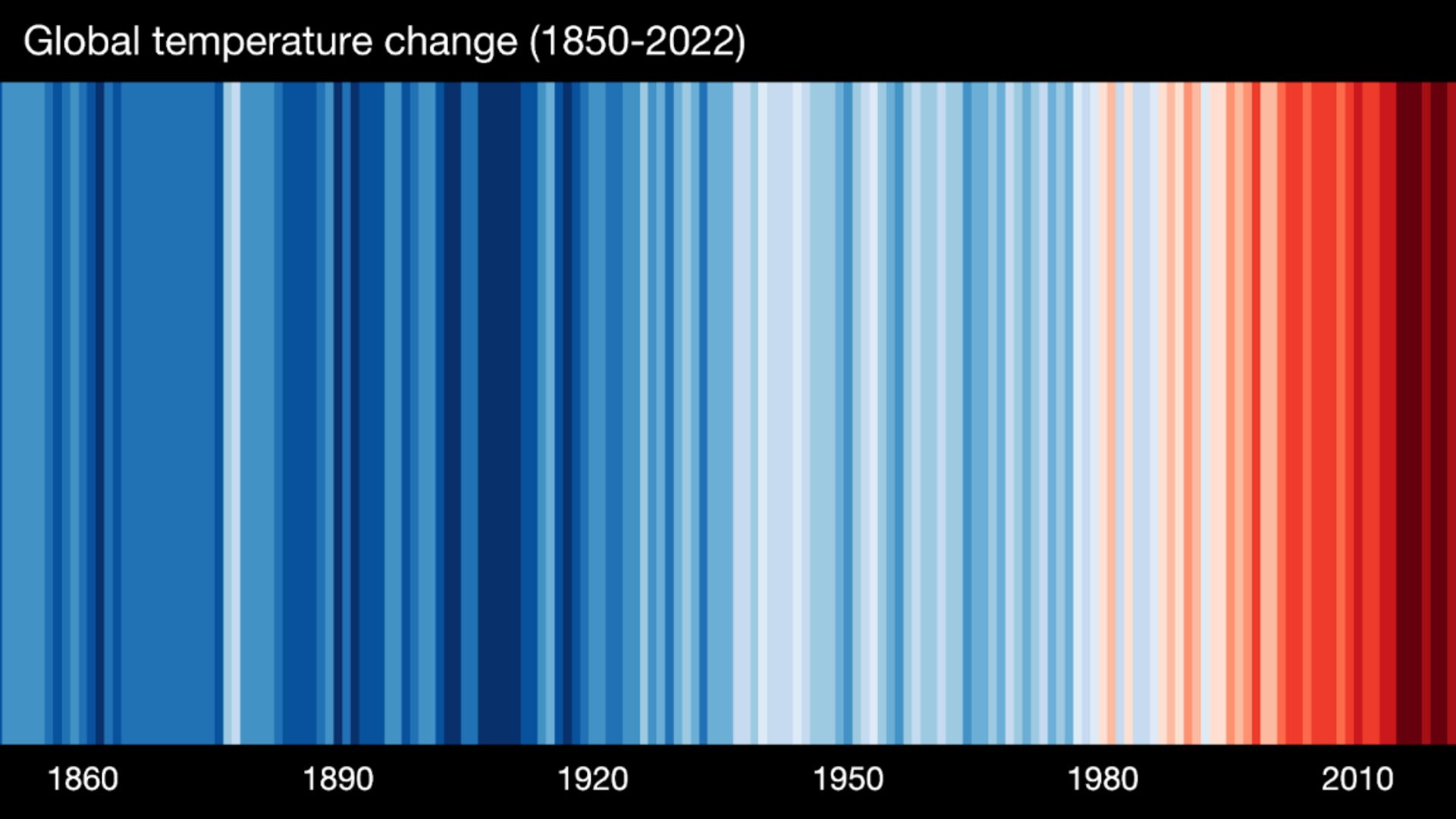
2024 is now reported as the warmest year on record. In fact, the increase in the average global temperature in 2024 reached 1.6°C (1). Given that the Paris Agreement, which was reached at COP21 in 2015, set, in its article 2, as a long-term limit that the increase in the average temperature of the Earth should remain well below 2°C, but also that measures should be taken to limit this increase as close to 1.5°C as possible, by 2100, compared to pre-industrial levels (1850-1900), it is important to analyze what the data regarding 2024 mean (2).
One of the most important consequences of climate change is global warming, and what plays a decisive role in the intensity of this situation is the anthropogenic greenhouse effect and greenhouse gases (GHGs). The continuous increase in CO2, methane and other important gases included in the list, have a decisive influence on the increase in temperature and in recent years their concentrations in the atmosphere have been increasing. A key factor in the increase in emissions of these gases is the combustion of fossil fuels. Lignite and oil are energy sources with large amounts of carbon dioxide emissions, while the so-called natural gas is a source of significant methane emissions (3).
In the diagram below, the colored lines show the change in the annual average temperature compared to the average temperature of pre-industrial levels (1850). The gray line depicts the evolution of CO2 emissions over time (1850-2023). Here, one can easily see that the increase in CO2 emissions and the increase in average temperature follow almost similar paths (4).

But what does this increase mean and what are the possible scenarios for the future?
The following graph, on the climate guide page, shows a representation of the IPCC (Intergovernmental Panel on Climate Change) forecasts, which presents the climate action scenarios and the subsequent degrees of increase in average temperature that are expected to occur by 2100 (5).

If 2100 seems far away, it is important to emphasize that the graph shows data up to 2022, where the increase in average temperature was 1.1-1.2°C, while very recently, the European Copernicus system announced that 2024 was:
- The warmest year ever recorded.
- The year with the highest value so far in average water temperature.
- The first year in which the increase in average temperature exceeded 1.5°C.
Specifically, the value recorded for the increase in average global temperature for 2024 was 1.6°C (1).
At this point, it is important to clarify that when reference is made to the limit of 1.5°C by the end of the 21st century, this refers to the long-term increase in temperature. As stated in the Paris Agreement, the aim is to limit the long-term temperature increase, which results from measurements of decades and not from data recorded in monthly or annual fluctuations. Monthly/annual temperatures, on the one hand, are indicative of a very dangerous trend and on the other hand, they are influenced and affect natural phenomena such as current variability (e.g. El Niño/La Niña). Therefore, the news about the 2024 data does not necessarily mean that the 1.5°C limit has been irreversibly exceeded (1). However, these data should be treated as critical signs for the course of climate change. Short-term exceedances are indications that the long-term limit is being dangerously approached and act as a “warning bell” for the need for increased climate ambition at the level of political decisions. The next decade is therefore crucial as it is the most important period for action to limit warming (1).
In the current context, trends show that the decade 2014-2024 was the warmest on record with an average temperature increase of 1.2°C above the period 1850–1900. At the same time, the 20-year average, with measurements between 2001–2020, shows an increase of 0.99°C compared to the reference period. According to the IPCC, every 0.1°C increase leads to more intense and frequent extremes of temperature and precipitation and significant agricultural and ecological drought in more and more areas (1).
More specifically, as the average global temperature increases, there are increased risks of crop failure, loss of biodiversity and more frequent and dangerous extreme weather events, such as heat waves, droughts, floods, fires. Events that lead to great losses in human lives – 489,000 deaths/year from heat waves have already been recorded in the period 2000–2019. 1.5°C is a tipping point for the climate and exceeding it, in the long term, is expected to bring about the collapse of ocean circulation systems, the melting of permanent ice at the North Pole, the collapse of tropical coral reefs and sudden, irreversible, and dangerous changes for humanity (1).
In the wake of the 6th IPCC report – which studies the entire scientific literature on climate change and presents the conclusions and scenarios of the scientific community in extensive regular reports, the UN climate committee presented a series of impacts for the future, depending on how far the increase in average temperature will go (UNFCCC).

These scenarios present – as shown in the image below – as a consequence of an increase of 1.5°C, a probability of complete disappearance of ice from the Arctic Ocean during the summer months of any year, at a rate of 3%. This possibility becomes 16% likely if the increase in average temperature is 2°C. While if the increase reaches 3°C, this probability reaches 63% (UNFCCC).

Similarly, as a consequence of an increase of 1.5°C, persistent droughts are expected to occur for periods of an average of 2 months per year. These periods reach 4 months if the average temperature increase is 2°C. While if the increase reaches 3°C, drought periods lasting 10 months on average per year are expected (UNFCCC).

Correspondingly, in the event of an increase in the average temperature by 1.5°C, a 41% increase in burned areas is predicted during an average Mediterranean summer. If the average temperature increase is 2°C, this percentage rises to 62%. If the increase is 3°C, we are talking about a 97% increase in burned areas per year (UNFCCC).

Finally, if the average temperature increases by 1.5°C, it is predicted that 4% of mammal species will lose half their population. If the average temperature increase is 2°C, this percentage doubles to 8% of mammal species. While if the increase reaches 3°C, 41% of mammal species will lose half their population (UNFCCC).

Humanity is at a critical crossroads
Recently, the US, one of the most polluting economies, withdrew for the second time from the Paris Agreement and its climate change targets. Greenhouse gas emissions must be reduced now to avoid irreversible impacts. This means a complete and immediate transition away from fossil fuels, a transition to a circular economy, and a reduction in the environmental footprint of human activities.
At the same time, there is widespread distrust of climate change and deliberate misinformation in order to prevent the previously profitable practices of the mineral industry from changing. This is why it is important to understand that every fraction of a degree °C plays a role in the intensity and frequency of extreme weather events and what our future will be like. And every gram of greenhouse gas emissions that are not emitted contributes to a better development for our lives. The changes that need to be made are many and many of them are big. But some are also in our own hands. And we must consciously answer the question: Which future do we choose?
Bibliography
- Copernicus: 2024 is the first year to exceed 1.5°C above pre-industrial level. Copernicus Climate Change Service . [Online] January 10, 2025. https://climate.copernicus.eu/copernicus-2024-first-year-exceed-15degc-above-pre-industrial-level.
- Paris Agreement . s.l. : UNFCCC, 2015.
- Fossil fuels and climate change: the facts. ClientEarth . [Online] February 18, 2022. https://www.clientearth.org/latest/news/fossil-fuels-and-climate-change-the-facts/.
- Climate Change, Credit Risk and Financial Stability. Oguntuase, Oluwaseun. 2020. 10.5772/intechopen.93304. .
- Infographics based on the IPCC’s 6th Assessment Report part 1 illustrate the physical science basis of climate change. climateguide. [Online] April 25, 2022. https://www.climateguide.fi/articles/infographics-based-on-the-ipccs-6th-assessment-report-part-1-illustrate-the-physical-science-basis-of-climate-change.